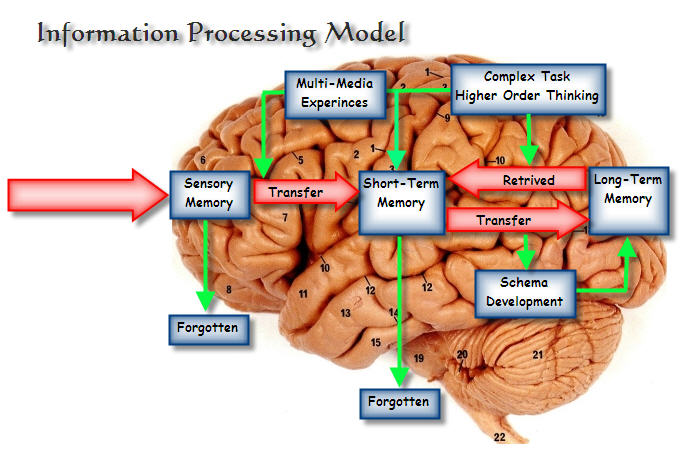
 At a moments notice the brain is responsible for processing or dismissing every bit of sensory information it receives. Our brain analyzes, quantifying, and helps us make sense out of our world.Information is taken in and we make either a conscious effort to try to retain information or an unconscious effort is made on our part to retain information: Sometimes the information we want to retain is lost before it reaches our short term memory and sometimes it is even lost once it reaches our short term memory.
As educators we endeavor to help students retain that which we teach because we believe their is value in that information. As such it is important to understand the various models with which we process information. Cognitive Psychology concerns itself with how the brain handles information: Much the same as a computer our brain process all the information we receive as mentioned. Like a computer and or internet network if we are receiving an information overload (lag) our "computer" slows down. How much information we can handle at any one memnet is defined as out attention capacity. While we have the ability to be selective in our attention stressors outside our control and/or experience might inhibit our ability to self select the information we want to act on: this is where the "fight/flight/freeze" concept comes into play.
According to McLeod (2007) our brain follows brain follows its own self defined set of laws: This is known as the nomothetic-idiographic debate amongst psychologists who study the brain and how it functions and relates to personality and decision making. Steve Pinker, a psychologist at Harvard University explains the cognitive approach in the following short video - Please watch:
The Informational Processing Model can be broken down into two essential elements:
1.) Serial processing: Essentially this means one process has to be completed before the next process starts. Think of connecting the dots in an orderly fashion.
2.) Parallel processing: Assumes some or all processes involved in a cognitive task(s) occur at the same time. Humans differ from computers in that we are primarily parallel processors while computers must process information in a serial (one at a time ) fashion.
According to McLeod the two main models within this school of though are the Broadbent's Filter Model and the Treisman's Attenuation Model. These models both assume that the stimulus (incoming information) is one part of the processing equation and what the subject brings to the situation enhances the processing of information: In the classroom setting this would be prior knowledge and/or skills related to the task being completed. Whereas Broadband's model notes that we filter out unwanted/needed information Treisman's model argues that what we actually do is attenuate it: that is, we just turn down the information we are not actively seeking to use. The models are pretty close in agreement on most other features of processing information excepting that, according to McLeod, the location of where the information is filtered is different in each model.
Classroom Instruction Application(s):
In the classroom we would want to focus on providing information to the students one chunk at a time. Ideally this information is presented in the smallest manageable packet at a time without insulting the intelligence of the students (i.e., do not make the material to simple). We would then begin to increase the amount and rate of information as well as the difficulty level of the material as the easier concepts are learned.
In a language arts class we might teach parts of a sentence such as nouns, verbs, adjectives then define these ideas into shades of the original such as common, abstract, proper, and concrete nouns. We would do the same with verbs and adjectives until the basic rules are understood and the students can master basic sentence structures: We then might have them work in groups (parallel processing) to develop evermore slightly complex sentence structures and be able to identify these ideas within each other's writing samples.
In a math class we might start with a simple cartesian coordinate system and then demonstrate basic linear equations and build up to more complex equations. As the students master the fundamental basics we move on to ever more complex instruction and applications/equations such as the life graph of a fruitfly and graphing the temperature drop of a known value for a cup of coffee in a freezer.
In elementary school we teach the students about the Pilgrims and the Indians and the first Thanksgiving Meal: they learn about cooperation and working together. As they grow in age and maturity we begin altering the narrative more towards reality and they learn of betrayal, inter tribal rivalries, alliances, disease, religious persecution, and the greater narrative of the actual First Thanksgiving story - something their young minds most certainly would not have fully grasped and appreciated at such a young developmental age. As the brain grows though it is able to process more efficiently and more effectively: It can handle greater amounts of data and can more readily process data that in its infancy it might not have been able to fully comprehend.
References
McLeod, S.A (2008) Cognitive Psychology Retrieved from http://www.simplypsychology.org/cognitive.html
McLeod, S.A.(2008) Information Processing. Retrieved from http://www.simplypsychology.org/information-processing.html
Diagram 1: Information Processing Model (n.d.) Retrieved from http://jaredmgriffin.files.wordpress.com/2011/05/information-processing-model.jpg

No comments:
Post a Comment